
Effective immediately the FAA Aircraft Registry announced on December 12, 2022 that it was restricting access to ancillary documents at the Registry to only Federal employees and Federal contractors. As a result, access to ancillary documents by Permit Holders (i.e. aircraft escrow agents and attorneys who specialize in aircraft registry matters) has been terminated. Ancillary documents include statements in support of registration filed for limited liability companies or partnerships, legal name change documents, powers of attorney, corporate merger documents, and trust documents.
The FAA stated this change was being implemented “because of concern about the inadvertent release of proprietary data and personally identifiable information (PII)”, and that “This decision is being made after careful Legal review regarding privacy concerns under the Trade Secrets Act (18 U.S.C. 1905) that prohibits disclosure of proprietary data, and the Privacy Act (5 U.S.C. 552a(b)) that prohibits disclosure of sensitive PII.”
Process change is always difficult, but implementation of this sweeping change during the busiest time of the year is worrisome, particularly with so many parties trying to close transactions prior to the end of the year. The most immediate impact that will be felt with regard to statements in support of registration. Since the statements already on file with the FAA will no longer be accessible to escrow agents and FAA registry attorneys, a new statement in support of registration may be needed, if the previously filed statement is not otherwise available. This is to ensure that the proper signatories and titles are included on the documents filed with the FAA.
We will keep you updated as Permit Holders, industry leaders, and the FAA work through possible solutions to address FAA concerns related to privacy and as new processes are developed.
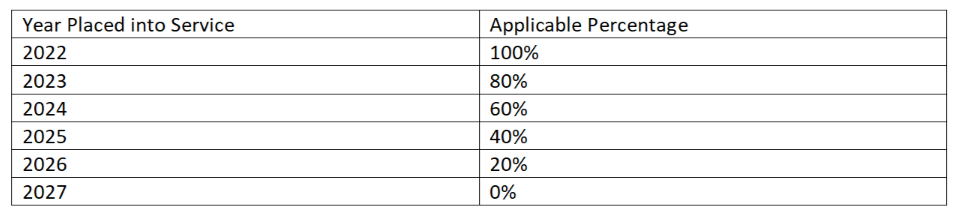 In addition to the percentages shown above, there is a one-year delay in the phasedown percentage for Certain Aircraft and Transportation Property. Certain Aircraft and Transportation Property are both defined in the TCJA. As a result, many aircraft transactions in 2023 will still be eligible for 100% bonus depreciation. In the alternative, the worst-case scenario for 2023, is that if an aircraft does not meet the definition of Certain Aircraft and/or Transportation Property, then the bonus depreciation amount available will be 80%.
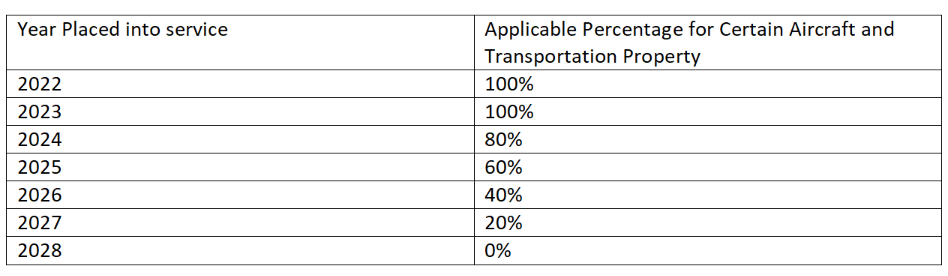 As has always been the case, just because an aircraft purchased by a buyer is eligible for bonus depreciation, that does not mean that the buyer automatically qualifies to take the bonus depreciation. The intended use of the aircraft (business vs. personal; within the United States or outside of the United States) and the specific tax situation of the buyer will need to be closely reviewed to determine eligibility to take bonus depreciation.